
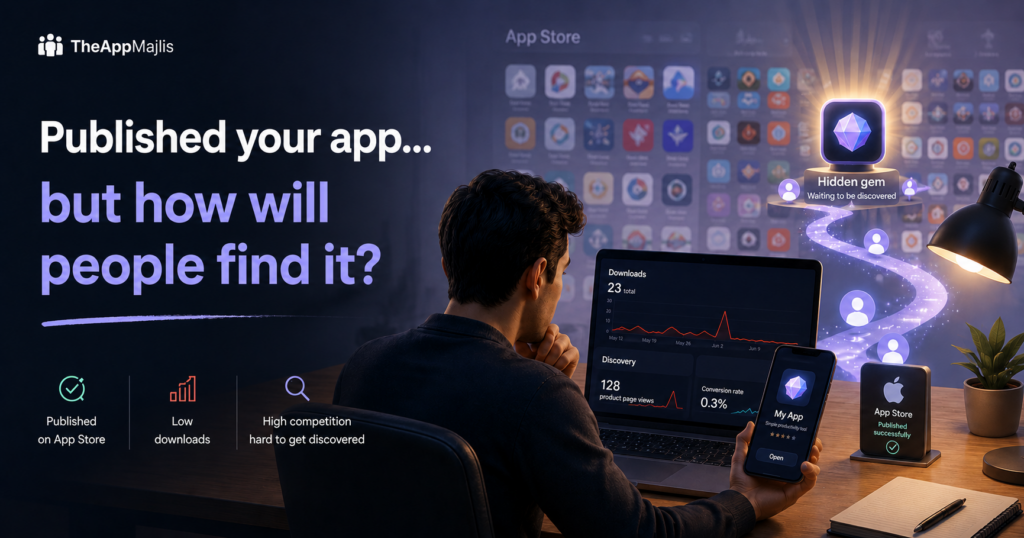
If you’re an indie developer, you’ve likely spent weeks—if not months—pouring your soul into your iOS app. You’ve written the code, obsessed over the user experience, polished the UI, and added every feature users might need. You’ve probably even set up In-App Purchases or subscriptions, hoping to finally see the revenue your hard work deserves.
Then comes the moment you’ve been waiting for: the notification that your app passed Apple’s review. You open the message and read:
“Your app has been accepted and is now Ready for Sale on the App Store.”
It’s an incredible rush, isn’t it?
You start imagining your app appearing before millions of users. You picture the downloads trickling in, followed by those first few bits of profit. You wait 24 or 48 hours, then open your Apple Search Ads or App Store Connect dashboard with excitement to check the daily results… only to be hit with a “0.”
Maybe you see one or two downloads. And let’s be honest—one of them is probably you.
You try sharing it with friends. You get a handful of downloads—maybe enough to count on your fingers—and then everything just… stops.
The Crowded Stadium
This is a feeling many indie developers know all too well, and I’m one of them. I started my journey on the App Store back in 2012, and I can tell you firsthand: there is a world of difference between launching an app years ago and trying to break through today’s noise.
Simply publishing an app is no longer enough. According to statistics, the App Store now hosts over 2.2 million appsand more than 960,000 publishers. You aren’t just competing with one or two rivals; you are trying to make your voice heard in a massive, overcrowded market filled with fellow indies, hungry startups, and tech giants with bottomless marketing budgets.
The Pay-to-Play Trap
You might decide to dip your toes into Apple Search Ads. You start with a modest daily budget—maybe $10 or $20. You wait for the results, only to find that your impressions are low and you need to hike up your “Cost-Per-Tap” just to enter the auction.
The hard truth starts to emerge: high-value keywords are a battlefield. There are companies that don’t mind spending thousands every month just to stay at the top.
Even if you do manage to snag some downloads, a new problem arises: conversion. Not everyone who downloads will buy. If your conversion rate to a paid subscription is only a few percent, the math becomes painful: your advertising costs might actually be higher than the revenue the app generates.
The Real Question
What is an indie developer supposed to do if their app is genuinely good, but they don’t have a massive marketing budget?
I truly believe there are incredible indie apps out there—hidden gems—that haven’t had a fair chance to reach users. These are apps built with passion, care, and real-world utility, but they’ve vanished into the crowd because they didn’t have someone to write about them, recommend them, or give them a spotlight.
That is why I decided to create:
TheAppMajlis
I want this to be a space where indie developers—especially from our region—can come together. A place to showcase our apps, tell our stories, and trade secrets about development, marketing, and the hurdles we all face after hitting that “Submit for Review” button.
This isn’t just another directory; it’s a “Majlis” (a gathering) for indie devs. It’s a place where we discover small apps that deserve attention and talk about the human stories behind them:
- How did it start?
- What problem does it solve?
- What challenges did the developer face?
- How can users support it?
Now, Over to You…
Do you have an indie app that you believe is a hidden gem the world hasn’t discovered yet?
Share your story with us. TheAppMajlis might just be the place where your app finally gets its time in the sun.